Trans-Québec 1
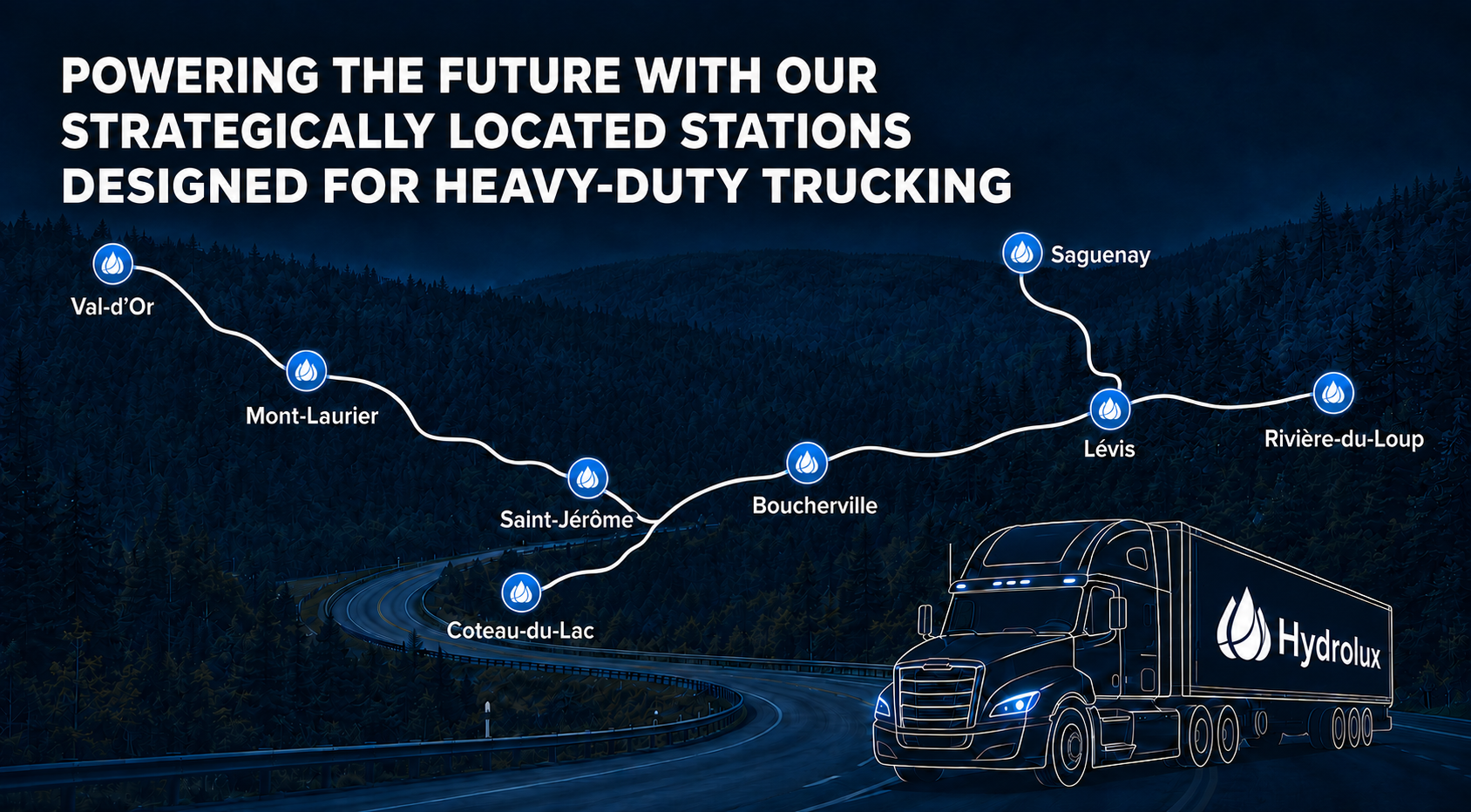
A planned network of eight stations making hydrogen accessible to fleets operating on Québec’s main corridors.
A network designed as corridor infrastructure
Trans-Québec 1 combines site development, local green hydrogen production where applicable, and refuelling equipment suited to heavy-duty trucking.
The network is structured to scale progressively in step with vehicle availability and operational conversion.
Trans-Québec 1 by the numbers
A structuring network connecting 97% of Québec’s population to many logistics hubs across Canada and the U.S. Northeast.
The network
Infrastructure and flexibility
Economic impact
Environmental impact
As of June 3, 2026. Equivalency based on the Natural Resources Canada greenhouse gas equivalencies calculator cited by Environment and Climate Change Canada (≈ 3.0 t CO₂e per gas-powered passenger vehicle per year).
Infrastructure developed over several years
Trans-Québec 1 is the result of sustained development, engineering and ecosystem mobilization. The next decisions will move the project from preparation to deployment.
Launch of Project 117
First stations planned in Val-d’Or and Saint-Jérôme to create an initial hydrogen trucking corridor.
Trans-Québec 1 is born
Project 117 expands into a station network connecting Québec’s main economic corridors.
Electric capacity requests
Submission of the requests required to power the stations and produce green hydrogen locally.
Advanced engineering and strategic agreements
Completion of Class 3 engineering under the AACE classification and strategic agreements supporting commercial development, energy distribution, financing and deployment of the first fleets.
Electric capacity and permitting
Securing electric capacity and obtaining the required permits to meet the conditions for final investment decisions.
Final investment decisions and construction
Final investment decisions, followed by the progressive launch of station construction and commissioning.
After several years of development, the completion of advanced engineering and the mobilization of strategic stakeholders, Trans-Québec 1 is ready to reach final investment decisions. Deployment now depends on securing electric capacity and obtaining the required permits.
Connecting Québec’s main routes
Val-d’Or
Gateway to Abitibi-Témiscamingue.
Mont-Laurier
A link between Abitibi, the Laurentians and southern Québec.
Saint-Jérôme
Access to Montréal’s North Shore and the Laurentians.
Coteau-du-Lac
Western corridor toward Ontario and interprovincial markets.
Boucherville
Montréal’s South Shore and the Highway 20 corridor.
Lévis
Québec City region and eastern corridors.
Saguenay
Serving Saguenay–Lac-Saint-Jean.
Rivière-du-Loup
Bas-Saint-Laurent and connections to eastern Canada.
Explore the reach of Trans-Québec 1
The isochrone map illustrates projected road coverage around the network’s eight sites.
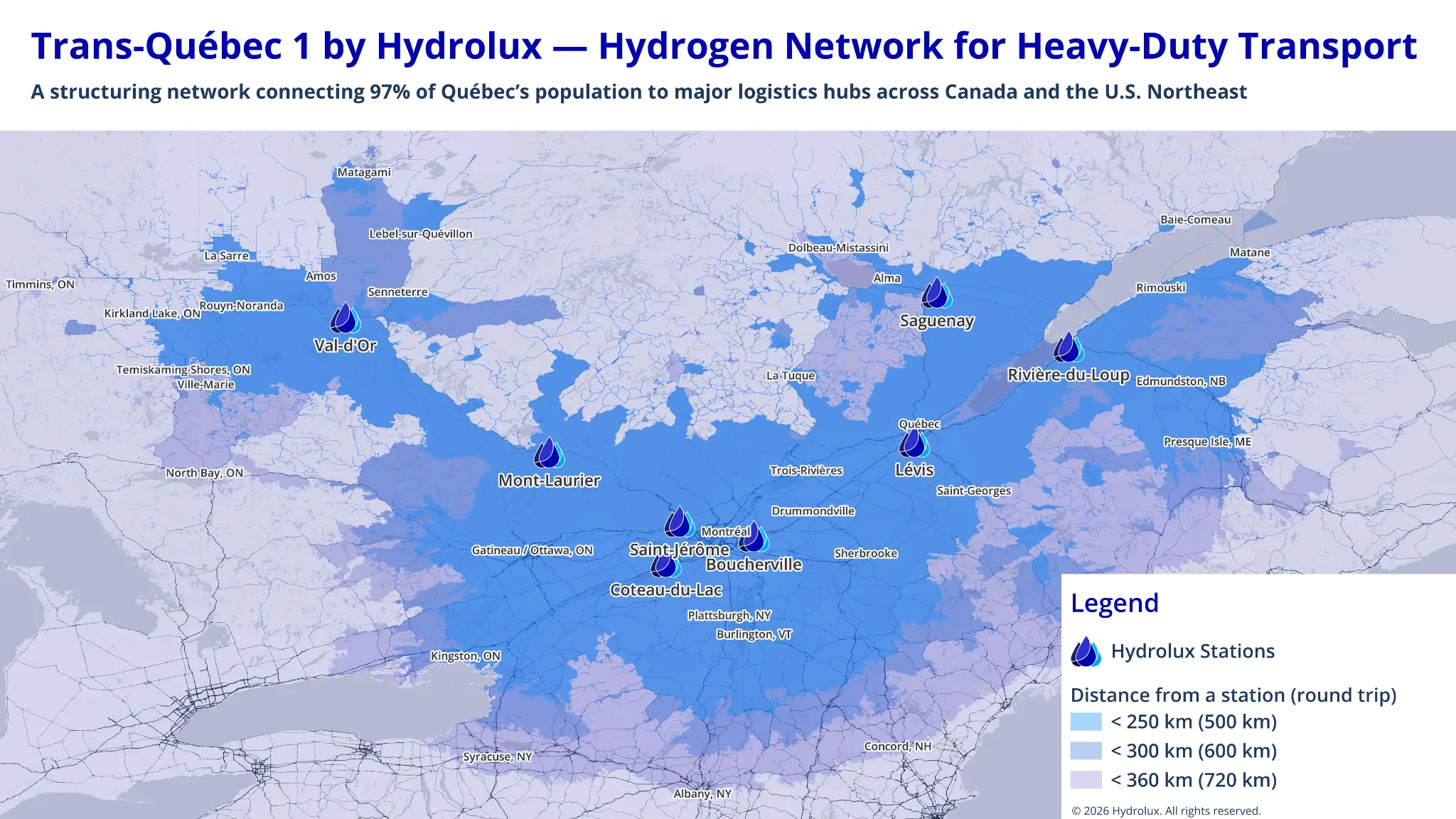
Indicative projection: actual range varies with the vehicle, payload, road conditions and operations.
Deploying supply and demand together
Qualify corridors
Identify routes, volumes, schedules and refuelling needs.
Prepare sites
Secure locations, the required electricity access, permits and technical integration.
Convert fleets
Align vehicle availability with the progressive opening of stations.
Do your routes intersect Trans-Québec 1?
Share your priority corridors so we can assess coverage, consumption and economic potential.